


Event date: October 1, 2026
Rules verified: October 2, 2026, 10:33 AM MDT
Next review: October 9, 2026, or sooner if ETF provides the final audit or a substantive response
The short version: Elite Trader Funding moved me toward LIVE ELITE and closed five 150K Elite Sim-Funded accounts before I received my first payout. To date, I have spent $3,646.14 with ETF and received $0 in payouts. At closure, the five dashboards showed $26,321.90 in combined simulated P&L. One detailed account showed 14 qualifying $200-profit days against an eight-day first-cycle requirement, $0 withdrawn, and “First Payout — Pending.”
This was not a technical failure or an allegation that ETF removed $26,321.90 of cash from a bank account. The balances were simulated, ETF's terms reserve broad discretion to move a trader live before a payout, and only $1,230.40 of the combined balances sat above the five published $155,100 safety nets at the captured moment. But the experience exposed a material condition every prospective buyer should understand before paying for multiple ETF accounts:
ETF's current help material says eligible sim value may instead be recorded in a LIVE ELITE Vault. That Vault is an internal performance ledger—not cash—and it releases value indirectly through 10% matches tied to future approved live withdrawals, balance-maintenance tests, and Day-90 reviews. In practical terms, more than $26,000 of displayed sim earnings can become conditional, slow-moving value while the actual 150K-or-above live starting balance is listed at $2,000, subject to ETF's audit and any qualifying billing credits.
That is why I am calling this a purchaser-beware warning. The transition may be permitted by the contract, and LIVE ELITE may ultimately be valuable. It is still materially different from the payout path many buyers may expect when they purchase and operate several simulated funded accounts.
What happened to my five accounts
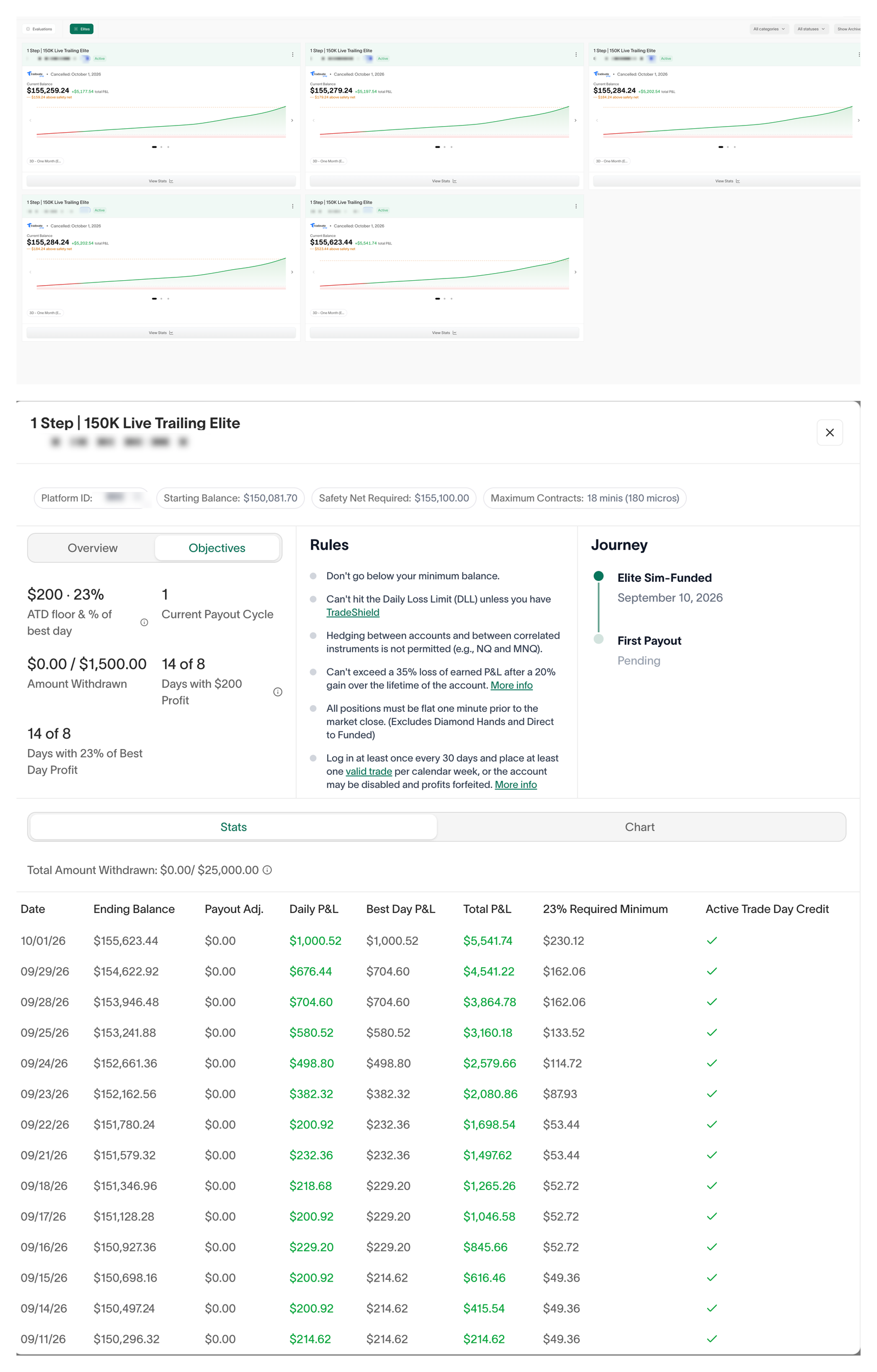
I was trading five 1 Step 150K Live Trailing Elite accounts. On October 1, 2026, the dashboard marked all five accounts “Cancelled.” Their displayed balances and total P&L were:
| Redacted account | Ending balance shown | Total simulated P&L shown | Amount above $155,100 safety net |
|---|---|---|---|
| Account A | $155,259.24 | $5,177.54 | $159.24 |
| Account B | $155,279.24 | $5,197.54 | $179.24 |
| Account C | $155,284.24 | $5,202.54 | $184.24 |
| Account D | $155,284.24 | $5,202.54 | $184.24 |
| Account E | $155,623.44 | $5,541.74 | $523.44 |
| Combined | $776,730.40 | $26,321.90 | $1,230.40 |
The “amount above safety net” column matters. ETF does not permit a sim payout to take a 150K account below its safety net. The five accounts displayed $26,321.90 in total simulated P&L, but most of that profit was supporting the five separate safety nets. At that instant, the combined headroom above those safety nets was $1,230.40.
That does not mean $1,230.40 was automatically payable. ETF's current 1 Step rules list a $250 minimum and a $1,500 maximum for the first reward cycle on a 150K account purchased on or after July 6, 2026. Four of the five cards showed less than $250 above safety net. The screenshots do not establish that every account had independently completed all payout conditions or that a payout request had been submitted on any account.
One account does document the timing problem clearly. Its detail view showed:
- 14 of 8 days with at least $200 profit;
- 14 of 8 days satisfying the 23%-of-best-day condition;
- $0.00 of a $1,500.00 current-cycle maximum withdrawn;
- $0.00 of $25,000.00 withdrawn overall;
- $5,541.74 total simulated P&L; and
- “First Payout — Pending.”
“Pending” here is the dashboard journey status, not proof that ETF had received or approved a withdrawal request. The narrower, fully supported statement is that I had received no payout before the transition.
What this has cost me
Based on my payment records, I have spent $3,646.14 with ETF to date. That is real money paid for access to the program—not simulated P&L—and I have not been allowed to collect a single payout before the firm moved me toward LIVE ELITE.
The economic snapshot is stark:
| Measure | Amount |
|---|---|
| My cash spent with ETF to date | $3,646.14 |
| Payouts I have received | $0.00 |
| Combined simulated P&L displayed across five accounts | $26,321.90 |
| Combined balance above the five safety nets at capture | $1,230.40 |
| Published 150K+ LIVE ELITE starting balance before possible credits | $2,000.00 |
Paying for an evaluation or funded-account program never guarantees a payout, and simulated P&L is not the same as cash. I understood that. What is disheartening is that I satisfied the visible first-cycle day requirements on the detailed account, accumulated profit across five accounts, and was then moved out of the sim program before I was permitted to receive even one payout against more than $3,600 of actual spending.
That personal cost is part of the purchaser-beware lesson. Buyers should not evaluate ETF solely by the advertised account size, profit split, or maximum payout. They should also model how much cash they may spend across evaluations, activations, subscriptions, and related account costs before ETF exercises its discretion to move them live.
The email did not present this as an optional milestone
ETF's Risk Team wrote that my accounts “are being transitioned to Live ELITE status.” It instructed me to stop placing trades while the firm completed a comprehensive audit. It also said gains accumulated during the interim period would not be considered toward my Live Elite status, that subscriptions would be terminated, and that a later email would explain the fee structure and account setup.
The message congratulated me and included a LIVE ELITE certificate. It did not state my final live starting balance, the amount ETF would record in my Vault, whether all five accounts were included in that calculation, the date live credentials would be issued, or the treatment of the first payout I had not yet received.
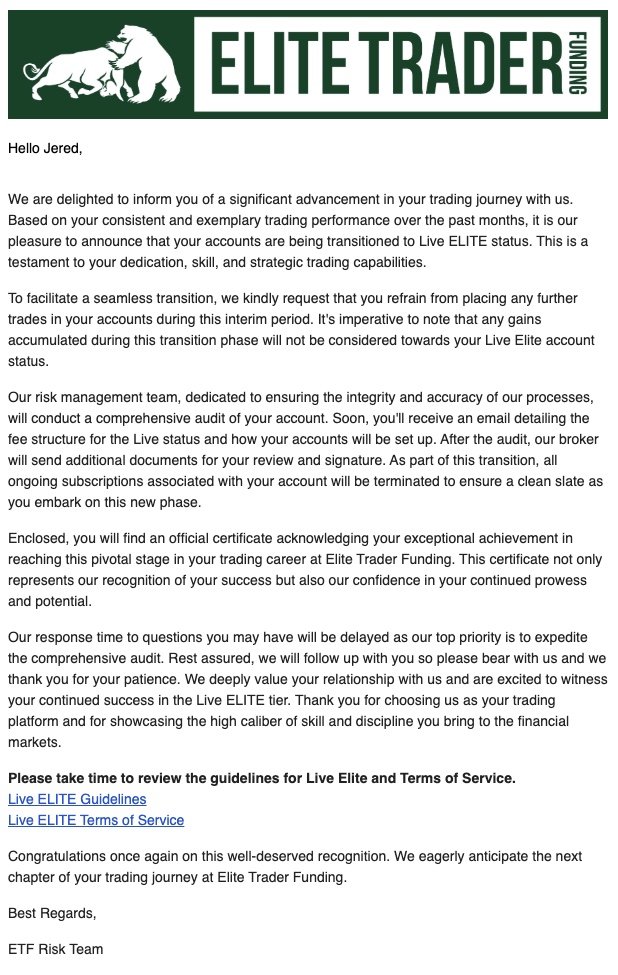
The tone was celebratory. The economic impact was not simple enough to fit that tone.
ETF's rules do allow an early live transition
This transition did not come out of nowhere in the legal terms. ETF's current public material contains two separate ideas that buyers should not confuse:
- Automatic-consideration milestones. A trader may qualify after five rewards, 50 Active Trading Days, or $25,000 in rewards, measured per trader.
- Discretionary early selection. ETF says it may move a trader to LIVE ELITE at any time—including during an evaluation, during the sim-funded stage, or before, during, or after a payout request.
The second rule controls this situation. The milestones do not promise that a trader can remain in sim until collecting five payouts or $25,000. ETF's Terms of Service say the firm can convert a trader at its “sole discretion” before a payout request, and that upon conversion all Elite Sim-Funded accounts close.
That language is a major purchasing term, not a minor graduation detail. Someone buying five accounts may model the purchase around five separate sim payout cycles. ETF's contract permits the firm to end that path as soon as it decides the trader belongs in live—even if the trader has never collected a sim payout.
What “$26,000 locked up” means—and what it does not mean
The phrase needs precision.
It does not mean I had an unconditional right to withdraw $26,321.90 on October 1. These were simulated accounts. Each account had its own safety net, minimum withdrawal, cycle limit, ATD rules, and audit. The screenshots show only $1,230.40 combined above the five safety nets, and only one card was above the currently published $250 minimum at the moment captured.
It does mean the five accounts displayed $26,321.90 of accumulated simulated trading profit immediately before they were closed, and that amount did not become cash or roll into the opening live balance. Under ETF's current help article, eligible remaining sim earnings are recorded in a separate LIVE ELITE Vault. The Vault is not a cash account and is never transferred to the broker. It funds matches equal to 10% of future normal live withdrawals.
If ETF confirms the full $26,321.90 as eligible Vault value, using all of it through a 10% match would require $263,219 in approved normal live withdrawals. That is simple arithmetic, not a forecast:
$26,321.90 ÷ 10% = $263,219.00
Even then, the match is not immediately payable. ETF says it adds matched company capital after each 30-calendar-day period; the trader must maintain a higher required balance; releases are reviewed at Day 90; and each Day-90 Vault reward is capped at $5,000. Unprotected Vault value and unreleased matches may be voided if the live account closes or is liquidated.
That is the “locked” part: the simulated performance may retain conditional value, but realizing that value requires substantial new performance in a smaller live account over time. Until ETF completes the audit, the actual Vault credit is unknown.
The likely live starting point is much smaller
ETF's current help article lists a fixed $2,000 LIVE ELITE starting balance for a qualifying 150K-or-above sim-funded account. It says the starting balance is based on the top-performing qualifying sim account—not the sum of all five displayed balances. For active evaluations, passed accounts, and active sim-funded accounts with no reward requested, ETF says the last billing payment may also be added.
My final number is not yet confirmed. The email expressly says the firm will provide the fee structure and account setup after its audit. Until that arrives, it would be inaccurate to state that I received exactly $2,000, that every billing payment will be credited, or that ETF has accepted $26,321.90 into the Vault.
The published structure nevertheless shows the scale of the transition:
| Before transition | Published LIVE ELITE structure | Status in my case |
|---|---|---|
| Five 150K sim-funded accounts | One fixed starting balance based on the top qualifying account | Final account setup pending audit |
| $26,321.90 displayed sim P&L | Eligible value may enter a separate Vault ledger | Final Vault calculation pending audit |
| Up to 100% sim reward split, subject to cycle rules | 80/20 normal live profit split | Published rule |
| Tradovate accounts in screenshots | LIVE ELITE is Rithmic-compatible; Tradovate and NinjaTrader are not supported | Platform migration expected |
| Five safety nets totaling $775,500 | $2,000 published starting balance for 150K+ qualification, plus possible qualifying credits | Final starting balance pending |
Accepting and declining are both consequential
ETF says a trader has three business days to accept a LIVE ELITE offer.
If I accept
The sim accounts remain closed. I begin trading real capital under the LIVE ELITE rules. Normal live profits above the onboarding balance can be requested on business days with a $250 minimum and an 80/20 split. Eligible sim value may be placed in the Vault, where it can fund 10% matches and potential Day-90 releases.
The trade-off is that the Vault is conditional. It is exposed to account-ending events, maintenance tests, release caps, and future performance requirements. The live account also carries real-market costs and a different platform setup.
If I decline
ETF's terms say the trader receives 5% of qualified sim earnings up to $12,500 and no more than 2% above $12,500, subject to KYC. The accounts close, and the trader is prohibited from using ETF's services for two calendar years.
If—and only if—ETF treated the entire displayed $26,321.90 as qualified earnings for this calculation, the result would be approximately $901.44:
($12,500 × 5%) + ($13,821.90 × 2%) = $901.44
That is an illustration, not an amount ETF has offered or confirmed. The firm determines qualified earnings as of the offer date, and the screenshots alone do not establish that calculation.
This is not a routine opt-out. The choice is effectively between entering the live program under its conditions or accepting a steeply discounted exit and a two-year ban.
LIVE ELITE rules buyers should understand
As verified October 2, 2026, ETF publicly describes the current program this way:
| Topic | Current first-party description | Why it matters |
|---|---|---|
| Selection | Five rewards, 50 ATDs, or $25,000 may trigger qualification; ETF may also move a trader at any time | A first sim payout is not guaranteed before conversion |
| Capital | Real capital in live markets | Live execution and loss exposure replace simulation |
| Profit split | 80% trader / 20% ETF | Different from the advertised “up to 100%” sim reward structure |
| Opening balance | $2,000 for a qualifying 150K+ sim account | Not the nominal 150K account size and not the sum of sim balances |
| Sim value | Eligible value may enter an internal Vault ledger | Not immediate cash or broker capital |
| Vault match | 10% of approved normal live withdrawals | Full use of a large Vault requires much larger future live withdrawals |
| Vault release | Day-90 review, up to $5,000 per release | Time, performance, and balance maintenance apply |
| Normal withdrawals | Daily business-day requests; $250 minimum; no stated maximum above onboarding balance | Attractive if the account remains profitable and eligible |
| Drawdown | End-of-day framework; no sim consistency rule | Rules change materially at transition |
| Risk intervention | Current help article lists session and lifetime-loss intervention thresholds | ETF can flatten, restrict, review, or close the account |
| Initial size | Five micros at $1,500 or less; ten micros at $2,000 or more | Much smaller than the 18-mini/180-micro sim limit shown in my screenshot |
| Data fees | $197 per month per exchange on the first account; another $197 for each additional account | Fees are deducted from the live balance until applicable coverage begins |
| Platform | Rithmic-compatible platforms; no Tradovate or NinjaTrader support | A trader may need a new workflow |
| Activity | Seven calendar days without genuine activity may close the account absent communication | Time away requires advance contact |
| Liquidation | No reset; possible discretionary Rebuild Path after a 14-day cooling period | Unprotected Vault value can be lost |
One first-party conflict needs a written answer
ETF's current landing page and LIVE ELITE help article advertise normal live withdrawal requests every business day. The current Terms of Service also contain a clause stating that traders may request payouts from “reserve amounts” in a LIVE ELITE account 30 ATDs after the previous payout.
Those statements may govern different buckets—normal live profits versus reserves/Vault value—but the Terms do not make that distinction clear in the cited clause. Before relying on “daily payouts,” a buyer should ask ETF to confirm in writing:
- which live balance can be withdrawn daily;
- what ETF means by “reserve amounts”;
- whether a first live withdrawal has any ATD waiting period; and
- how the 30-ATD clause interacts with the newer Vault structure.
Why I believe buyers deserve a clearer warning
The strongest defense of ETF's policy is straightforward: real funding is the stated destination, the firm is putting capital at risk, and the current terms disclose broad transition discretion. Moving a profitable trader live can be a legitimate positive outcome.
The strongest criticism is equally straightforward: the economic value of several sim-funded accounts changes dramatically when ETF invokes that discretion before the trader's first payout. A buyer can satisfy the visible first-cycle requirements, see thousands in P&L across several accounts, and still have those accounts closed before receiving a normal sim reward. The remaining value may be transformed into a conditional ledger that requires far more future live performance to realize.
In my case, that happened after $3,646.14 of actual spending and before one dollar of payout. Whatever the legal mechanics, that outcome is deeply disheartening and materially different from the purchasing expectation created by a program centered on reaching funded payouts.
Both facts can be true. The rule can be contractually disclosed and still deserve much more prominent treatment on pricing pages, plan comparisons, checkout screens, and payout calculators.
The words “get moved to live” sound like a pure upgrade. Buyers should be shown the full transaction:
- all sim accounts close;
- a first sim payout is not guaranteed;
- the opening live balance is fixed and may be far smaller than displayed sim P&L;
- eligible sim value is not immediate cash;
- Vault value is realized only through conditional matches and reviews;
- fees, platform support, contract limits, and risk rules change; and
- declining can mean a small formula payment and a two-year prohibition.
Could this be a sign of liquidity pressure?
It is a reasonable possibility to investigate, but this case does not prove that ETF has a liquidity problem.
From a cash-flow perspective, an early LIVE ELITE conversion changes when and how much money ETF may have to pay. If the trader accepts, ordinary sim payouts stop and eligible sim earnings move into a conditional Vault that is realized only through 10% matches on future live withdrawals. If the trader declines, the published formula pays only 5% of the first $12,500 of qualified earnings and up to 2% above that amount. Either outcome can produce a smaller near-term cash outflow than allowing five profitable sim accounts to continue through normal reward cycles.
That economic incentive is why an unexpected wave of pre-payout conversions could be a warning signal. A firm experiencing liquidity pressure might use the same mechanics to conserve cash, defer obligations, or tie more payments to future trader performance.
But “could” is doing important work in that sentence. The same conduct can also follow ETF's stated business model: identify profitable traders, stop carrying several simulated accounts, and move selected traders onto actual firm capital with tighter limits. One trader's transition cannot distinguish between normal risk management and cash conservation.
ETF currently states that it has paid more than $13 million to more than 13,000 funded traders and advertises a 48-hour approval guarantee for eligible payouts. Those are first-party marketing claims, not audited financial statements, bank records, or proof of present liquidity. I did not find a first-party notice stating that ETF had paused payouts or was experiencing a liquidity problem as of October 2, 2026. Conversely, the absence of such a notice does not establish financial strength.
Evidence that would materially strengthen or weaken the liquidity concern would include:
- the number of traders moved to LIVE ELITE before a first payout, by month;
- the dollar value of sim rewards requested, approved, paid, converted, or placed into Vault;
- payout aging and the number of eligible requests that exceeded the advertised guarantee;
- the amount of unprotected Vault value later voided after live-account closure;
- audited or independently verified payout and cash-reserve information; and
- a direct ETF explanation of whether cash-flow considerations affect early-transition decisions.
Until ETF provides that information, the responsible conclusion is limited: the policy creates a cash-conservation effect and therefore raises a legitimate liquidity question, but the available evidence is not sufficient to diagnose liquidity distress.
What I am waiting for ETF to confirm
This article will be updated with ETF's written response if one arrives. The outstanding questions are:
- Why were five accounts moved before any first payout rather than after a normal sim reward?
- What exact amount from each account qualifies for the new LIVE ELITE Vault?
- Does the Vault include all $26,321.90 of displayed P&L, only earnings above the safety nets, or another audited figure?
- What is the final live onboarding balance, including any billing-payment credits?
- Will there be one live account or multiple accounts?
- What is the exact deadline to accept, and when did the three-business-day clock begin?
- What would the decline payout be in dollars for this specific offer?
- Do normal live withdrawals begin immediately, and what does the Terms of Service's 30-ATD “reserve amounts” clause cover?
- What amount of Vault value becomes void if the live account closes before its drawdown becomes static?
- Which fees will be deducted before the first live trade?
- Did cash-flow or liquidity considerations play any role in moving these accounts before the first payout, and how many other traders were moved before a first payout in the last 90 days?
- How much of my $3,646.14 in documented spending will be credited to the live starting balance, and which charges receive no credit?
Until those questions are answered, readers should treat every unconfirmed account-specific amount as pending.
A purchaser-beware checklist
Before buying one ETF account—especially before buying five—save the current rules and get comfortable with these questions:
- Would you still buy if ETF moved you live before your first sim payout?
- Do you understand the difference between total simulated P&L, profit above the safety net, a qualified reward, the live onboarding balance, and the Vault ledger?
- Can your strategy operate with the published live micro-contract limit and Rithmic-compatible platforms?
- Can a $2,000 opening balance absorb monthly data, platform, commission, and liquidation costs?
- Are you willing to trade consistently enough to avoid the seven-day inactivity rule?
- Can you maintain the higher balance created by Vault matches through a Day-90 review?
- Are you comfortable with ETF's discretion to change allocation, contract limits, risk parameters, and payout eligibility?
- If you decline, are you prepared for the formula payout and two-year restriction?
Do not model the purchase as “five accounts times five guaranteed payout streams.” ETF's current terms do not promise that outcome.
Bottom line
I entered ETF's simulated funded program expecting to reach my first payout cycle. I have spent $3,646.14 with ETF to date and received no payout. Instead, after the five accounts displayed $26,321.90 in combined simulated P&L, ETF closed them and notified me that I was being transitioned to LIVE ELITE.
ETF appears to have contractual discretion to do that. That is precisely why prospective buyers need to know about it before purchasing.
LIVE ELITE could still prove valuable: it uses real capital, offers an 80/20 split, and advertises uncapped normal live withdrawals. But the move is not the same as receiving the sim profits already displayed. The opening live balance is much smaller, and the new Vault converts eligible sim value into a conditional long-term matching mechanism.
My conclusion is not “ETF stole $26,000.” The documented conclusion is more specific: ETF moved me live before my first payout, closed five sim-funded accounts, and placed more than $26,000 of displayed sim performance behind a new set of conditions before I could realize a normal sim reward.
The structure also reduces ETF's immediate sim-payout exposure, which raises a fair question about liquidity incentives. It does not, by itself, prove ETF is insolvent, unable to pay, or currently experiencing financial distress.
That is a rule every buyer should price into the decision from day one.

Current Firm Offers and Direct Links
Open the firm in a new tab with the recorded ComparePropFirms commercial link. Use the displayed code when applicable, and confirm the final price and terms before paying.
CPF
Use our code CPF for Tradeify’s current sale: 30% off every plan, ending October 15, 2026 at 11:59 PM EST (their public code this month is GEMS).
Commercial terms verified October 1, 2026 · Recheck at checkout
Visit Tradeify →
Purdia Capital
Current code SEPT60
Check the current offer and final price at checkout.
Commercial terms verified 2026-10-01 · Recheck at checkout
Visit Purdia Capital →
Bulenox
Current code KVG6G
Verification due — KVG6G is past the fourteen-day confirmation window and its affiliate coupon table requires login. Confirm current checkout terms; the affiliate desk must also recheck this quota-limited coupon daily while active.
Commercial terms verified August 28, 2026 · Recheck at checkout
Visit Bulenox →
Official sources
- Elite Trader Funding Terms of Service — last updated August 14, 2026; checked October 2, 2026. See the LIVE ELITE conversion discretion, account closure, decline formula, payout, and SMART Growth/Vault provisions.
- LIVE ELITE Program Information — checked October 2, 2026. See selection, onboarding, starting balances, Vault calculations, matching/release rules, costs, platforms, activity, liquidation, and Rebuild Path.
- LIVE ELITE overview — checked October 2, 2026. See the public 80/20 split, daily-withdrawal claim, starting balances, costs, and transition summary.
- How Do Rewards Work? — checked October 2, 2026. See the current 1 Step reward-cycle minimums, maximums, and purchase-date rules.
- Consistency Rule and Active Trade Days Explained — checked October 2, 2026. See the $200/23% ATD test and standard 8/10/10/10 schedule.
- ETF Payouts — checked October 2, 2026. ETF's first-party claim of $13 million-plus paid to more than 13,000 funded traders; not an audited liquidity disclosure.
- Author-supplied ETF dashboard, transition email, and certificate — captured October 1–2, 2026; identifiers redacted in publication copies.